
China got manufacturing. India is getting finance.
Table of Contents
If you want to understand what’s happening in global finance and accounting outsourcing, think in terms of geopolitics, not just jobs.
The United States once made a strategic decision: “We cannot manufacture everything here. Let manufacturing move to China.”
Today, another decision is happening quietly but decisively: “We cannot staff everything here. Let finance and accounting outsourcing move to India.”
This shift is not happening simply because India is cheaper. It is happening because India is structurally positioned for it.
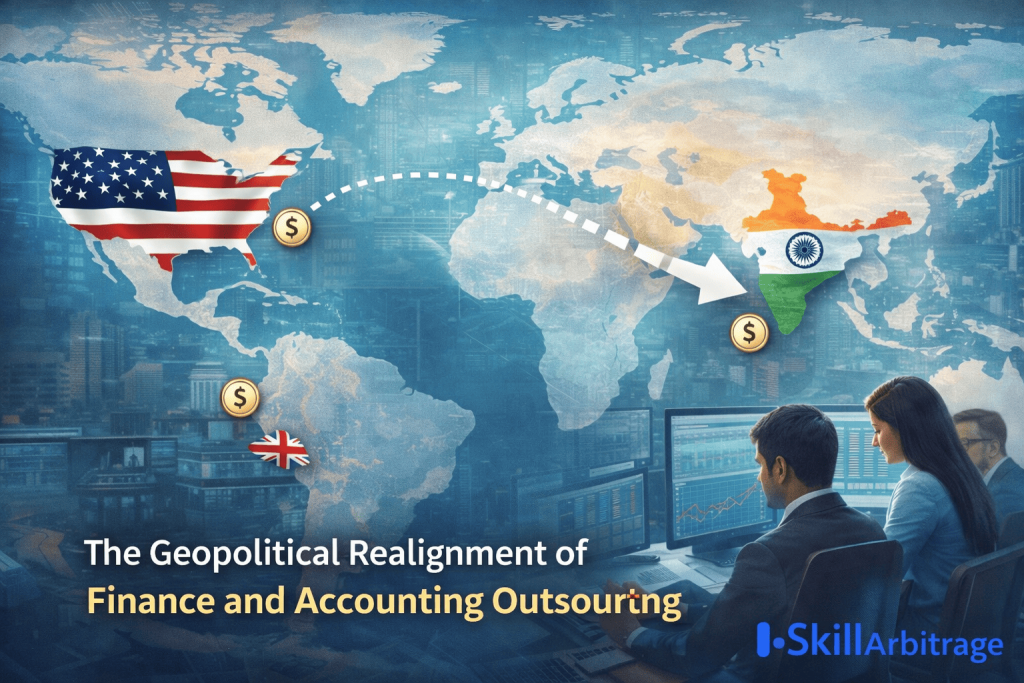
The Geopolitical Realignment of Finance and Accounting Outsourcing
The global balance of white-collar work is changing.
India is:
- Young while the West is aging
- English-speaking while Europe remains fragmented
- Credential-rich while the US accounting pipeline is shrinking
- Tech-ready while many economies remain paper-heavy
- Timezone-aligned with overnight delivery cycles
- Culturally compatible with Western business norms
- Home to over 1,700 Global Capability Centers (GCCs) running finance at scale
This is not traditional “outsourcing.”
This is structural realignment.
In the same way Shenzhen became the world’s factory floor, cities like Ahmedabad, Jaipur, Pune, Indore, and Kochi are emerging as the world’s finance back offices.
And we are still early.
The biggest story in global talent is not AI.
It is the repositioning of financial operations from West to East through finance and accounting outsourcing.
How Big Is the Finance and Accounting Outsourcing Opportunity?
Now let’s look at the math.
India already exports approximately $387 billion in services annually, and that number continues to grow.
According to the World Bank’s services export data, India’s services exports have grown steadily over the last decade.
OPEC’s total crude oil export revenue is estimated at around $550 billion in 2024.
Meanwhile, the global finance and accounting outsourcing market alone is already above $50 billion and projected to approach $80 billion by 2030.

Industry research by Grand View Research estimates continued growth in the finance and accounting outsourcing market.
Now consider this:
India produces millions of graduates every year, with commerce representing a significant share. Yet employability remains a challenge.
If India trains 1 million accountants for global markets, and each exports just $10,000 to $30,000 worth of services annually, that alone generates $10–30 billion in additional service exports.
That rivals what several mid-tier oil-exporting nations generate from crude oil.
And this stacks on top of India’s existing services base.
Add natural growth in IT, BPO, GCCs, and high-value consulting, and India begins to resemble the “Saudi Arabia of services.”
Finance and accounting outsourcing could become one of India’s most powerful white-collar export engines.
The Skill Gap Slowing India’s Finance and Accounting Outsourcing Growth
But there is a catch.
Right now, most Indian commerce graduates are not trained for global finance work.
The training gap is real:
- They know accounting theory, but not real-world month-end closes
- They haven’t worked on QuickBooks Online, Xero, NetSuite, SAP, A2X, Stripe, Shopify, or Amazon Seller Central
- They understand Indian GST, but not US GAAP, IFRS, UK GAAP, US tax, or UK VAT
- They memorize standards but struggle with reconciliations, cash flow building, and consolidations
- They lack exposure to asynchronous work using Slack, Loom, ClickUp, and structured documentation
- They are rarely taught pricing, proposals, scope documents, or export compliance
- AI tools are not integrated into finance workflows during training
While demand for finance and accounting outsourcing is rising globally, India must close this capability gap to fully capture the opportunity.
What 1 Million “Global-Ready” Accountants Must Learn
If India wants to lead in finance and accounting outsourcing, global-ready professionals must develop:
1. Strong Core Foundations
Applied accounting fundamentals, financial statements, ratios, and cash flow — built around real businesses, not exam scenarios.
2. Global Standards
Working knowledge of US GAAP, basic IFRS, US tax concepts, UK VAT, and at least one major compliance system.
3. Tool Stack Mastery
Hands-on experience with:
- QuickBooks Online or Xero
- At least one ERP (NetSuite, SAP, Oracle)
- E-commerce tools like A2X, Stripe, PayPal, Shopify, and Amazon
4. Workflow Ownership
End-to-end control over:
- Accounts Payable (AP)
- Accounts Receivable (AR)
- Bank reconciliations
- Inventory tracking
- Revenue recognition
- Month-end close
5. Specialization
Niches such as:
- E-commerce accounting
- SaaS KPIs and revenue recognition
- Real estate accounting
- Healthcare accounting
- Fund accounting
6. Automation & AI Integration
Using RPA, Zapier, Make, and AI tools to:
- Draft reports
- Clean data
- Identify anomalies
- Increase client capacity without increasing headcount
7. Communication & Business Skills
- Clear written English
- Structured updates
- Dashboard reporting
- Loom explanations
- Pricing in dollars
- Retainer agreements
- Indian service export compliance
If India builds even 1 million professionals with this profile, we are not just participating in finance and accounting outsourcing.
We are building the world’s largest white-collar export engine.
Bigger Than Jobs — A National Economic Shift
Do you see how this is bigger than getting a job?
China did not become the world’s factory overnight.
It required skill-building, infrastructure investment, and global standardization.
India’s opportunity in finance and accounting outsourcing follows the same logic.
But the raw material here is not steel or silicon.
It is talent.
The professionals who recognize this shift and equip themselves accordingly will not just find better careers.
They will help define India’s next economic identity.
The shift is already underway.
The question is whether India will lead it, or merely receive it.





 Allow notifications