Academic writing is a niche segment in the market, and while we’ve had quite a substantial discourse on the same, there are things that writers might happen upon before they get started.
So in this blog, we’re answering the three most critical questions asked from our SkillArbitrage community:
- “Can I use AI for academic research and writing? To what extent? Can I write full-blown articles with it?”
- “Will AI replace my role in respect of academic writing assignments that I can perform for global clients?”
- “What if my work gets flagged by AI detectors? What are the ethical issues involved here?”
Everyone’s confused because for the first time in history, technology isn’t just helping us search for information… It’s starting to generate it.
And if you’ve spent years building your expertise around reading, writing, and thinking, this might come as a little threatening to you.
However, to tell you the truth, AI isn’t replacing writers, researchers, or educators.
It’s replacing slow, unstructured, and repetitive work, not the people who think deeply and write clearly.
AI won’t take your job, but someone using AI better than you might.
The truth is, AI on its own isn’t intelligent. It’s powerful only in the hands of a human who knows how to think, verify, and connect ideas.
The real future isn’t AI or humans: it’s AI + humans.
Because AI can process information, but only people can make meaning out of it.
Every breakthrough you’ll see in the coming years will come with this duo: AI + Human
Tools like Trinka.ai, Claude, and ChatGPT can already:
- Summarise 30 research papers in 5 minutes.
- Suggest journal formats and citation styles.
- Catch grammar or tone inconsistencies instantly.
That doesn’t mean they can replace you.
Because AI is just a machine. It doesn’t understand context, argument, or academic accuracy. It predicts words; it doesn’t reason.
So while AI can summarise, it still needs you to:
- Add progressive ideas and narratives
- Add on your recent human interactions and experience
- Verify every source
- Spot logical gaps
- Rewrite in a tone that fits the research’s purpose
That’s why AI does things middle to middle, not end to end. It speeds up your process, but you still own the direction and the finish line.
In other words, AI can help you do 60-70% of the groundwork faster, but it still takes a human to finish the job.

Here’s where you should use AI (and where you shouldn’t)
AI can be used for:
- Literature reviews: summarising papers, mapping research gaps, and organising findings.
- Manuscript structuring: outlining IMRAD sections, improving flow, and refining clarity.
- Data analysis & visualisation: cleaning datasets, generating charts, and identifying key patterns.
- Grant proposals: polishing aims, significance, and formatting per global guidelines.
- Cross-cultural adaptation: rephrasing survey tools or content for international contexts.
- Editing & proofreading: ensuring academic tone, grammar, and consistency.
- Reference management: integrating Zotero/Mendeley for citations and reformatting.
Skip AI use for:
- Copying full papers or summarising without checking the source.
- Relying on AI for fact-checking or referencing.
- Creating fake citations or data (clients and software can detect this instantly).
- Submitting AI-written text without rewriting it in your own words.
- Using technical terms outside your subject expertise without verification.
- Using AI to summarise confidential or unpublished client data without explicit permission (violates NDAs and data-protection laws).
- Generating statistical outputs without checking formulas or data sources.
Think of it this way: AI should never be your voice.
It should be your assistant. Your co-pilot.
In fact, it’s like having a team of fifty junior researchers and editors working with you at once. Ready to fact-check, brainstorm, refine your ideas, or even challenge your assumptions.
You don’t have to spend on staffing or management; you already have that team at your fingertips.
The difference is, you’re still the one leading, questioning, and deciding what matters.
But is it ethical to use AI?
Absolutely, if you use it transparently and intelligently.
Here’s what global professors and journals care about:
- Original thought: Your argument, synthesis, or insight.
- Source verification: That your references and citations are accurate + verified.
- Clarity: That your writing communicates ideas cleanly.
If AI helps you format, polish, and present better, that’s not unethical. It’s efficient.
You’re still the author of the idea; AI just helps you think faster, structure better, and see angles you might have missed.
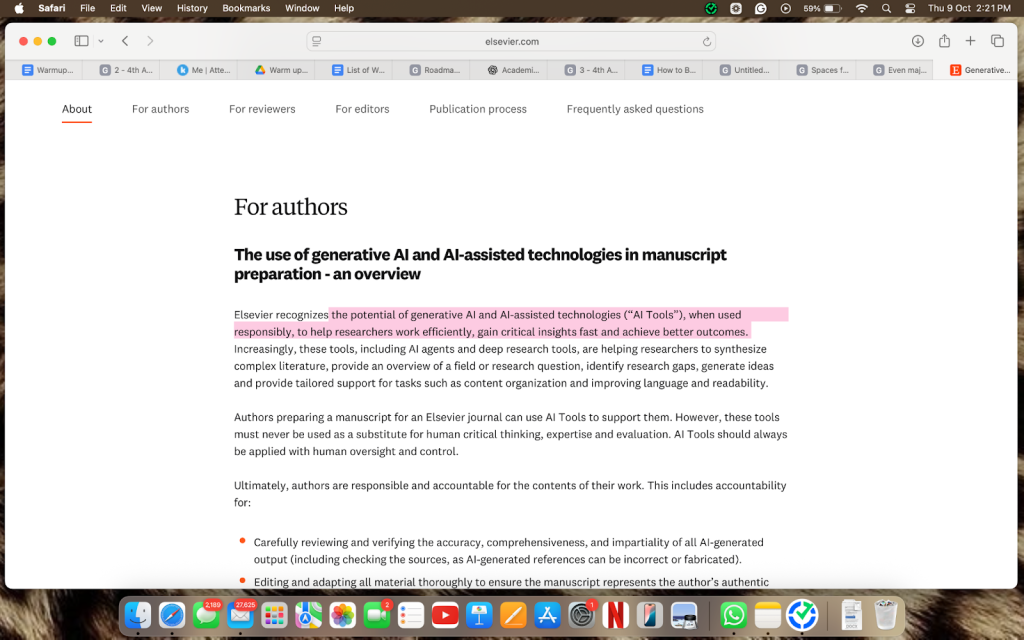
Even major journals like Nature and Elsevier have published guidelines confirming this: you can use AI tools for editing and analysis, just don’t list them as co-authors or submit their text unedited.

And it’s not just writers who are learning this lesson. Even the biggest players in tech and consulting are discovering the boundaries of this new AI wave.
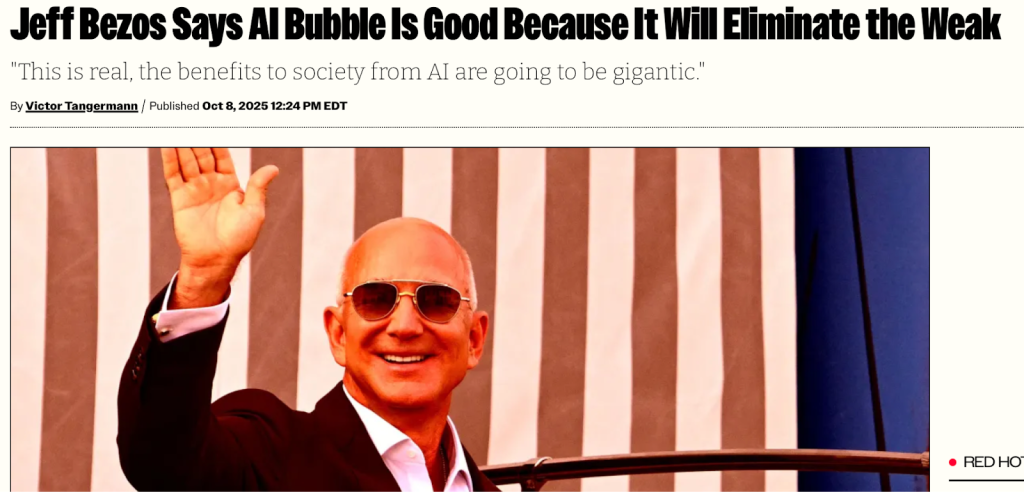
Sam Altman, the CEO of OpenAI & Jeff Bezos, founder of Amazon, recently admitted that the “AI hype bubble” will burst for anyone expecting machines to replace human expertise.
Jeff Bezos said it best: “AI will amplify your potential, but it still needs your judgment.”
Source- News18.com
Just a few days ago, Deloitte was asked torefund part of a $440,000 fee to the Australian government after using generative AI in producing a financial report that contained multiple errors. Proof that blind dependence on automation can be more expensive than the effort to think critically.
Can clients detect if AI use?
Yes, but here’s the catch: they’re not looking for AI use, they’re looking for AI abuse.
Clients care about:
- Accuracy of citations
- Clarity and originality.
- Whether you can discuss your own writing with adequate academic corroboration.
If you use AI for rough work: summarising, drafting, refining, and reviewing, AI is just a tool used in the process of original research and writing, like your own laptop or smartphone.
Generating AI-driven articles or copying and pasting entire paragraphs can cost you both credibility and clients.
Remember: detectors don’t flag good writing; they flag lazy writing.
Which AI tools should you actually use, and do you need to pay for them?
You don’t need to buy everything. Here’s a practical list:
| Purpose | Free/Low-Cost Tools | Paid (Optional) |
| Grammar & Clarity | Trinka.ai (free tier), Grammarly | Trinka Premium, LanguageTool Pro |
| Literature Review | ChatGPT (free), Claude | ChatGPT Plus ($20/mo), Claude Pro |
| Reference Management | Zotero, Mendeley | None needed |
| Data Visualisation | Google Sheets, Tableau Public | Tableau Pro (optional) |
| Plagiarism & AI Check | QuillBot, GPTZero (free) | Turnitin (institutional access) |
The right tools cost less than your monthly Netflix plan and can save you hours of work every week.
The Bottom Line: AI isn’t your replacement. It’s your multiplier.
Writers who ignore AI will fall behind.
Writers who learn to collaborate with it will lead the next decade of global work.
So stop worrying about being replaced and start learning how to use these tools to save time, improve quality, and earn more.
You don’t have to be a tech expert to use AI; you just need curiosity and the willingness to experiment.
Every great writer, researcher, and teacher you admire is learning these tools the same way: one prompt, one project, one small success at a time.



 Allow notifications