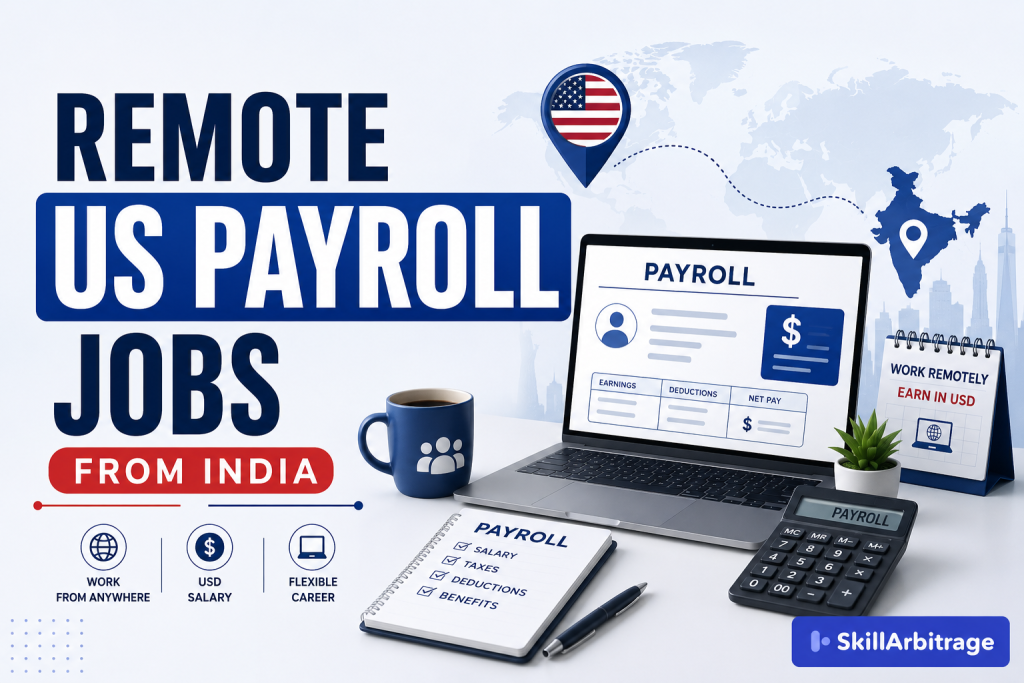

Remote US payroll jobs are open to India-based professionals through three routes: a global capability centre or BPO payroll desk running on US shift, a direct role with a US employer arranged through an employer-of-record, and independent contractor work billed to US accounting firms. All three screen on the same thing, federal and multi-state compliance knowledge, rather than on a degree. The US Bureau of Labor Statistics places payroll and timekeeping clerks inside its financial clerks category, which recorded a median wage of $48,650 in May 2024 and is projected to shrink 5% between 2024 and 2034 while still turning over about 102,200 openings a year, every one of them from replacement rather than growth. Automation is taking the keying, not the judgement.
This article sets out where remote US payroll jobs sit, what US payroll rules employers screen for, and how to apply from India.
The timing is unusual. For tax year 2026 the IRS has added three codes to Box 12 of Form W-2, among them code TT for qualified overtime compensation and code TP for qualified tips, and both are mandatory on the returns due 1 February 2027. Every US employer with hourly staff now files a figure it has never had to calculate before, and the teams being asked to absorb it were mostly thin already.
Hiring routes for remote US payroll jobs
The hiring routes for remote US payroll jobs number three, and they differ in who employs the worker, who carries the compliance risk, and when the work actually happens. Picking the wrong one costs a candidate months, because each route screens on something different.
The largest is the global capability centre or BPO payroll desk. Listings on Naukri.com and Indeed India for US payroll roles typically ask for two to eight years in US payroll process, name Microsoft Excel, ADP and SAP as the working tools, and set the shift at 6:00 pm to 3:30 am IST so the desk overlaps the American working day. The employer here is the Indian entity, which matters more than it sounds. Compliance exposure sits with the client, and the desk is measured on service-level agreements rather than on filings.
Route two is a direct role with a US employer, arranged through an employer-of-record or a global payroll provider. The provider employs the worker on its Indian entity while the reporting line runs into the US finance or people team. Work on this route is usually broader, covering the full cycle instead of one process step.
Route three is independent contractor work billed to a US accounting firm, CPA practice or bookkeeping outsourcer. The paperwork is short but it isn’t optional. According to the IRS, Form W-8BEN certifies non-US status, goes to the payer rather than to the IRS, and stays in effect through the end of the third calendar year after it is signed. Without one on file, US-source payments to a foreign person face 30% withholding.
And the form most Indian freelancers expect never arrives. Where the person is foreign and the services are performed outside the United States, the payer generally issues no Form 1099-NEC at all, which is a different position from the one that applies to a US-based contractor. Anyone who has read a 1099 filing-season guide written for a domestic audience should read that distinction twice.
So how deep is the market these three routes feed off? The Bureau of Labor Statistics projects financial clerk employment to fall 5% between 2024 and 2034 and names productivity-enhancing technology as the specific brake on demand for payroll and timekeeping clerks. And yet the same projection carries roughly 102,200 openings a year, every one of them replacement rather than growth.
Read the $48,650 median recorded in May 2024 for what it is. That’s a US-payroll benchmark for US-based staff, a measure of how deep the work runs, and it is not what an India-based specialist is offered.
One limit runs through all three routes and rarely appears in a job advertisement. Form 941 has to be signed by a principal officer or owner of the business, or by a duly authorised agent holding a valid power of attorney. Offshore roles therefore scope to preparation, reconciliation, variance investigation and employee support, and stop short of filing authority. A candidate who understands that boundary interviews better than one who claims the whole cycle.
The nearest neighbour to this work is US medical billing, which travels across a border for the same reason: both run on written evidence and a submission calendar rather than on physical presence. Anyone weighing remote medical billing work against payroll is comparing two calendars, not two different kinds of skill.
US payroll rules employers screen for
The US payroll rules employers screen for are federal deposit timing, FLSA overtime arithmetic and multi-state withholding, in that order. Interviews test them as calculations, not as definitions.
Start with the Fair Labor Standards Act, because it sets the number every downstream figure depends on. The Department of Labor requires overtime for hours worked over 40 in a workweek at a rate not less than one and one-half times the regular rate of pay. A workweek is a fixed and regularly recurring period of 168 hours, meaning seven consecutive 24-hour periods, and it does not have to match the calendar week.
Averaging hours over two or more weeks is not permitted. That single line is where candidates trained on Indian payroll most often slip, because a 32-hour week followed by a 48-hour week produces eight hours of overtime under US rules, not zero.

The 2026 rates come from the IRS instructions for Form 941. Social security runs at 6.2% each for employee and employer on a wage base of $184,500. Medicare runs at 1.45% each with no wage base limit at all. Additional Medicare Tax of 0.9% applies to wages above $200,000 for a single employee, withheld from the employee only, with no employer match.
Then comes the calendar. Form 941 falls due on 30 April, 31 July, 31 October and 31 January, and which deposit schedule applies is decided by the lookback period. Reported taxes of $50,000 or less make an employer a monthly depositor, due by the 15th of the following month. Anything above that makes it a semiweekly depositor.
Semiweekly is where the arithmetic turns unforgiving. Wages paid Wednesday through Friday are deposited by the following Wednesday, and wages paid Saturday through Tuesday by the following Friday. A monthly depositor that accumulates a $100,000 liability on any single day becomes a semiweekly depositor the next day, mid-quarter, without warning.
Multi-state work adds the third layer. Unemployment insurance contributions are owed in the state where the employee works, at rates that vary by state and by the employer’s own experience rating. Sixteen states plus the District of Columbia hold reciprocity agreements, under which the employer withholds only for the employee’s home state. Symmetry’s compliance guidance puts most remote-worker failures down to a stale work-location record rather than a broken calculation.
Now the new field. For tax year 2026 the IRS added Box 12 code TT for qualified overtime compensation and code TP for qualified tips to Form W-2, both mandatory, both due by 1 February 2027. Code TT is narrower than the payslip line sitting next to it: it carries only the premium half of time-and-a-half required by the FLSA, so state-law-only premiums such as California’s daily overtime and its double time above the federal floor are excluded.
Here’s what that actually looks like. An employee paid 22 dollars an hour works 46 hours in one workweek. The regular rate is 22 dollars, the six overtime hours are paid at 33 dollars each, and the overtime line on the payslip reads 198 dollars. Box 12 code TT does not carry 198 dollars. It carries the premium half alone: six hours at 11 dollars, so 66 dollars.
So why does that one figure keep surfacing in interviews? Because it is the shortest test of whether a candidate can separate what a payslip shows from what a form requires, and 2026 is the first year anyone has had to.

How to land remote US payroll jobs from India
Landing remote US payroll jobs from India runs in four steps: credential, software, evidence, then applications. Reversing that order is the most common reason a capable candidate never clears a screen.
The credential is PayrollOrg’s Fundamental Payroll Certification. PayrollOrg states the FPC is open to all and lists no prerequisite and no experience requirement, which makes it the one payroll credential an India-based candidate can sit before ever holding a US payroll role. The exam runs 150 questions in three hours, and members save more than 20% off the fee.
The windows are fixed and worth diarising. Registration for the autumn 2026 sitting runs from 1 July to 2 October 2026, with exams held between 5 September and 3 October 2026. The spring 2027 window takes registrations from 9 November 2026 to 16 April 2027 and runs exams from 4 January to 17 April 2027. Exams administered across that band test federal law in effect as of 1 January 2026, so the rules a candidate studies are the ones in force this tax year.
Certification isn’t a one-off. Keeping the FPC takes 60 recertification credit hours over three years. The senior credential, the Certified Payroll Professional, is experience-gated three ways: three of the last five years in payroll practice, or 24 months plus specified coursework, or 18 months plus the FPC plus coursework. It takes 120 credit hours over five years to maintain, which places it at year three or later rather than at the start.
Software is the second filter, and listings name it plainly: Microsoft Excel, ADP and SAP. Hands-on access is the obstacle, since enterprise payroll systems aren’t handed to people who don’t already have a job inside one. The practical workaround is to certify on a platform that opens its training to individuals, which is why the QuickBooks ProAdvisor route is worth pricing before spending money on anything else.
Evidence is the third step, and it’s where most applications are thin. A reconciliation note is the cheapest credible artefact a candidate can produce, it takes an evening, and it shows a hiring manager how the person thinks rather than what they claim. Attach one written in this shape:
Quarter: Q3. Total wages per the payroll register, 412,500 dollars, agreeing to Form 941 line 2 with no variance. Pre-tax section 125 deductions of 14,300 dollars reduce taxable social security wages to 398,200 dollars, which is the figure carried to line 5a. Cross-check: 398,200 dollars at the combined 12.4% employee and employer rate gives 49,376.80 dollars, agreeing to social security accrued in the general ledger.
Applications come last. Naukri.com, Indeed India and Glassdoor India carry the GCC and BPO listings, and those are the fastest route to a first US payroll role because the training sits inside the job. Global payroll and employer-of-record providers advertise the direct-hire roles. Contractor work is different in kind: US accounting firms and bookkeeping outsourcers respond to a scoped proposal rather than to a resume, and the rate conversation follows its own logic, which the pricing guide for US clients sets out.
One condition is better known before signing than after. Processing weeks are deadline-bound, and the US overlap is not negotiable inside them. Listings that set 6:00 pm to 3:30 am IST are describing the payroll cycle rather than stating a preference.
So what separates a shortlisted application from a screened-out one? Usually a single line of evidence that the candidate has done the arithmetic, rather than a longer list of the tools they have seen.
Frequently asked questions
Is a US degree or a CPA licence needed for remote US payroll work?
No. PayrollOrg lists no prerequisite and no experience requirement for the Fundamental Payroll Certification, and screening runs on federal rules, multi-state withholding and payroll software. A CPA licence belongs to the accounting track, not to payroll.
Are remote US payroll jobs from India night-shift roles?
Largely, during processing weeks. Listings on Indian job boards commonly set the shift at 6:00 pm to 3:30 am IST so the desk overlaps the American working day. Payroll deadlines are fixed, so the overlap is heaviest around each pay date and at quarter-end.
Can an India-based payroll specialist file a US employer’s tax returns?
No. Form 941 must be signed by a principal officer or owner, or by a duly authorised agent holding a valid power of attorney. Offshore roles scope to preparation, reconciliation and employee support, which is why job descriptions set out the cycle but never the signature.
Does an Indian contractor receive a Form 1099 from a US client?
Generally no. Where the contractor is a foreign person, the services are performed outside the United States and a valid Form W-8BEN is on file, the payer typically issues no Form 1099-NEC. The W-8BEN goes to the payer, never to the IRS.
References
- US Bureau of Labor Statistics, Occupational Outlook Handbook: Financial Clerks
- Internal Revenue Service, Instructions for Form 941
- Internal Revenue Service, General Instructions for Forms W-2 and W-3 (2026)
- Internal Revenue Service, About Form W-8 BEN
- US Department of Labor, Wage and Hour Division, Overtime Pay
- PayrollOrg, Fundamental Payroll Certification
- PayrollOrg, Recertification Overview
- Symmetry, Multi-State Payroll Tax Compliance
This article is for informational and educational purposes only. It does not constitute professional, financial, legal, tax or immigration advice. Payroll rules, filing dates and certification requirements change. Consult a qualified professional before acting on any tax, compliance or career decision.





 Allow notifications