


What if you could work with international universities, think tanks, and research teams from your home in India without relocating, without a PhD, and starting part time? The global academic writing career is no longer a niche opportunity reserved for academics. It is a fast growing, high income remote profession that thousands of Indian professionals are quietly building right now.
Table of Contents
Why Global Academic Writing Is a Real Career in 2026
Academic and research writing is one of the fastest growing global industries right now, and professionals from every background are already a part of it.
Let me show you a bigger picture.
- US universities invested $108 billion in research in a single year — every study, report, and proposal behind that number needed skilled writing support.
- 11,000+ think tanks operate globally, each producing policy briefs, white papers, and research summaries on a continuous basis.
- The global technical writing industry is valued at $3.8 billion and growing.
- The medical writing sector is expanding at 10–12% annually — one of the fastest-growing writing specialisations worldwide.
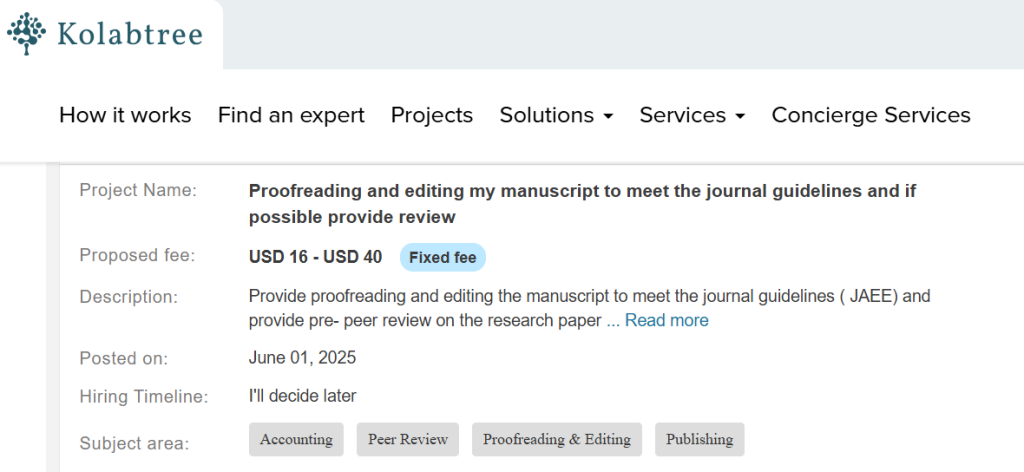
- Indian freelancers on platforms like Kolabtree and Upwork are already earning $30–$100/hour for specialised academic writing and research projects.
The 6-Month Roadmap to Your First Global Client
Here is the structured path that has worked for hundreds of academic writers. It is built around three phases: building proof, earning your first fees, and scaling into high-value specialisation.
Month 1–2: Build the Basics and Show Proof
Your goal in the first two months is not income, it is credibility. You are building the proof that you can do this work.
Skills to acquire:
- Editing, proofreading, and manuscript formatting.
- Citation management using Zotero or Mendeley.
- AI-assisted writing tools: Trinka.ai for academic grammar, ChatGPT and Claude for summarisation.
- Structuring short literature reviews and article summaries.
Portfolio and outreach:
Create a Notion portfolio page with two or three writing samples: a literature review and an academic summary. This is enough to establish credibility with early-stage clients. Begin connecting with researchers and professors on LinkedIn and ResearchGate. Send five to ten short, personalised introductory messages each week.
Send 5–10 short, friendly introduction messages every week. Something as simple as, “I enjoyed your recent paper on and even summarised a few key insights. I’d love to collaborate if you ever need help with editing or review work”
Use this phase to collect your first two testimonials, even from unpaid or volunteer projects. Early proof is the foundation for everything that follows.
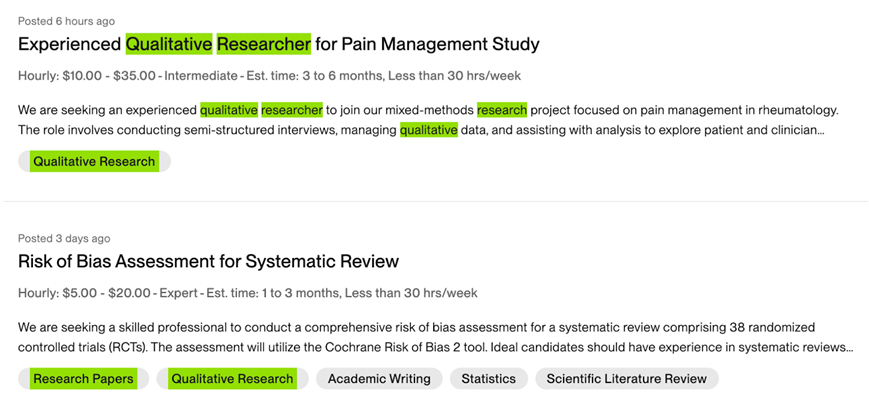
Earning potential: in Month 1–2: $5–$15/hour (₹40,000–80,000/month part-time). Beginners on Kolabtree and Upwork consistently reach this range within their first few months.
Month 3–4: Land Paid Projects and Build Momentum
Now that you have proof, the focus shifts to getting paid. You are moving beyond editing into research assistance and writing.
Work you can take on at this stage:
- Literature reviews and research gap identification.
- Report writing and data interpretation for NGOs and think tanks.
- Policy summaries and project documentation.
- Journal article formatting and final editing.
Skills to develop:
- Conducting literature searches using Claude, ChatGPT, and Google Scholar Advanced Search.
- Writing executive summaries, abstracts, and short research reports.
- Formatting for publication in APA, MLA, and Chicago styles.
- Using Zotero and Notion together for structured reference management.
Portfolio and outreach:
Add two to three live samples to your portfolio. Share one short research insight each week on LinkedIn a summary or key takeaway from a paper you have read. Begin reaching out to assistant professors, edtech founders, and think tank researchers with personalised daily pitches.

Here’s an example of a short, clear messages:
“Dear [name (with honorifics, like Dr, prof., if any)],
I loved your recent interview/publication/research paper etc/ congrats on winning the XYZ [if it is some award]! – [Always start with appreciation – related to something which is truly worthy of praise]
I help professionals like you to get in the world’s top podcasts relevant to <industry> which massively help their personal brand.
I have helped _ people to do exactly that. Look at the kind of coverage they got here, here and here <attach links>.
Can we jump on a quick zoom call to explore how I can help you take your personal brand to the next level within weeks? I need just 15 mins of your time, will send across some slots if you are interested.
Regards,
Your name”
Just 5–10 messages like this daily can get you your first collaboration.
Earning potential: in Month 3–4: $15–$30/hour (₹80,000–1.5 lakh/month). Projects in this range are consistently available on Upwork, Guru, and Kolabtree once you have two to three strong samples.
Month 5–6: Specialise and Scale Your Income
This is where the real earning power unlocks. With a track record of completed projects and client testimonials, you can move into high-value work that commands rates universities, R&D teams, and NGOs will readily pay.
High-value specialisations to consider:
- Grant proposal writing: helping professors and research institutions apply for competitive funding.
- Technical or medical writing: partnering with biotech, pharma, or software research teams.
- Data analysis and visualisation: turning survey results and research datasets into charts and insights.
- Curriculum and course content for edtechs: creating structured, well-researched content for online learning platforms.
Skills to master:
- Writing research proposals: Specific Aims, Significance, Innovation sections.
- Data cleaning, summarising, and formatting using AI tools.
- Visualising findings with Excel or Tableau.
- Structuring long-form academic or policy reports.
- Creating long-form technical, medical, or policy papers.
- Managing multi-project timelines and maintaining long-term client relationships.
Portfolio and outreach:
Upgrade your Notion portfolio with case studies that show tangible results. Examples: “Helped client submit grant proposal to NSF” or “Edited journal article accepted by Scopus-indexed journal.”
Expand your network to include:
- research organisations
- NGOs
- R&D teams
- funding agencies
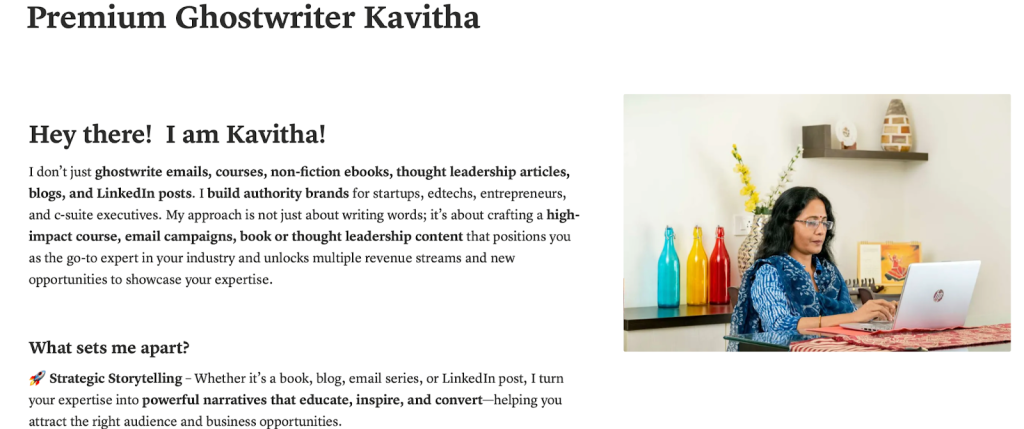
Here are a couple of our learners who have built incredible Notion portfolios:
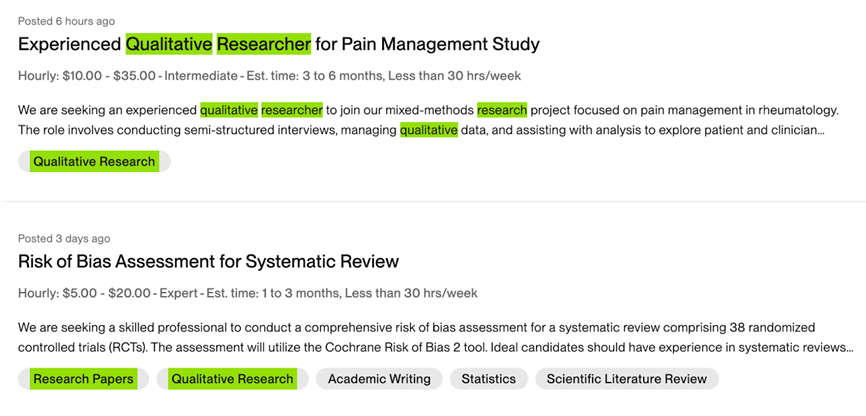
Earning potential: in Month 5–6: $30–$100/hour (₹2–5 lakh/month). Many writers continue this part-time. Others go full-time once their client base stabilises and the most ambitious build their own agencies, hiring junior writers for support work.
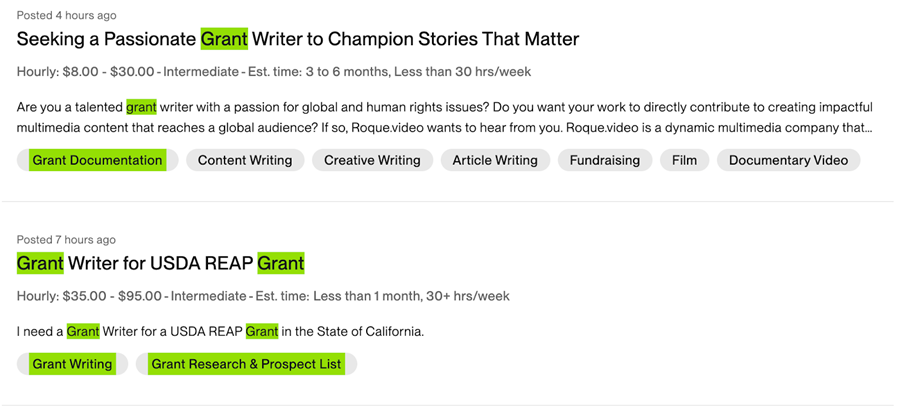
By the end of month six, your goal is concrete: 1-2 consistent clients, 5-7 strong testimonials, and a visible presence on at least one major platform. At that point, your skills, outreach, and track record are working together as a self-reinforcing system.
Once you have a steady stream of work, you can scale from here:
- hire a small team
- handle multiple projects
- collaborate with research agencies
This is exactly how companies like Cactus Communications and Enago began: small freelance teams that now work with hundreds of universities and publishers worldwide.
Skill Arbitrage learners
Several SkillArbitrage learners are already doing this, earning ₹1–2 lakh/month consistently or more as they scale.
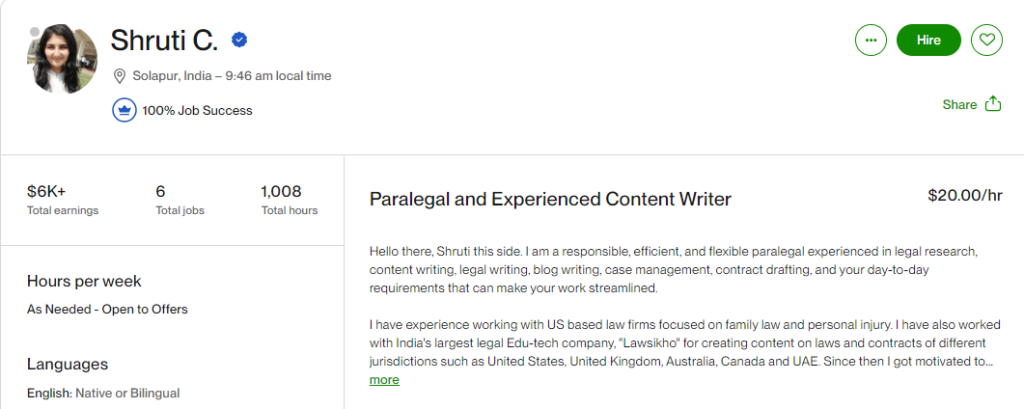
- Shruti Chincholkar, a 2023 graduate from Solapur, created her profile and landed her first client within a month. She specializes in content, blog, and research writing for clients in the US, UK, Canada, UAE, Australia, and Singapore. She has completed 6 projects and earned over USD 6000.
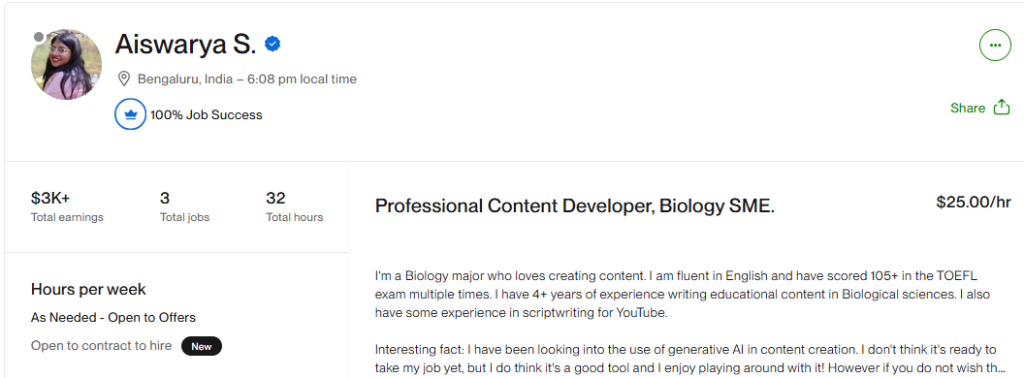
2. Aiswarya Sivanand, is one of our learners from Jatani. She secured her first international freelance writing opportunity within 3 months and has earned over USD 3,000 through ongoing educational content projects in biological sciences.
These are not exceptional outcomes. They are the result of a clear skill-building plan, a credible portfolio, and consistent outreach. The pattern repeats for writers who follow the same structured approach.
Can You Start Without a Research Background?
Absolutely Yes, and this is the question that stops most people from ever beginning. The answer is worth stating clearly: you do not need a research background to build a global academic writing career. You need the ability to understand, summarise, and communicate ideas clearly.
You can start this part-time: evenings, weekends, or a few hours after work. Many professionals who now earn ₹2–5 lakh per month from academic writing started with one evening per week and their first unpaid sample project.
Why This Works (And Why Now)
- Because AI can assist but not replace analytical writing.
- Because the world’s research ecosystem is starving for clear communicators.
- And because India finally has the skill, trust, and infrastructure to deliver globally from anywhere.
The ones who start early will lead the wave.





 Allow notifications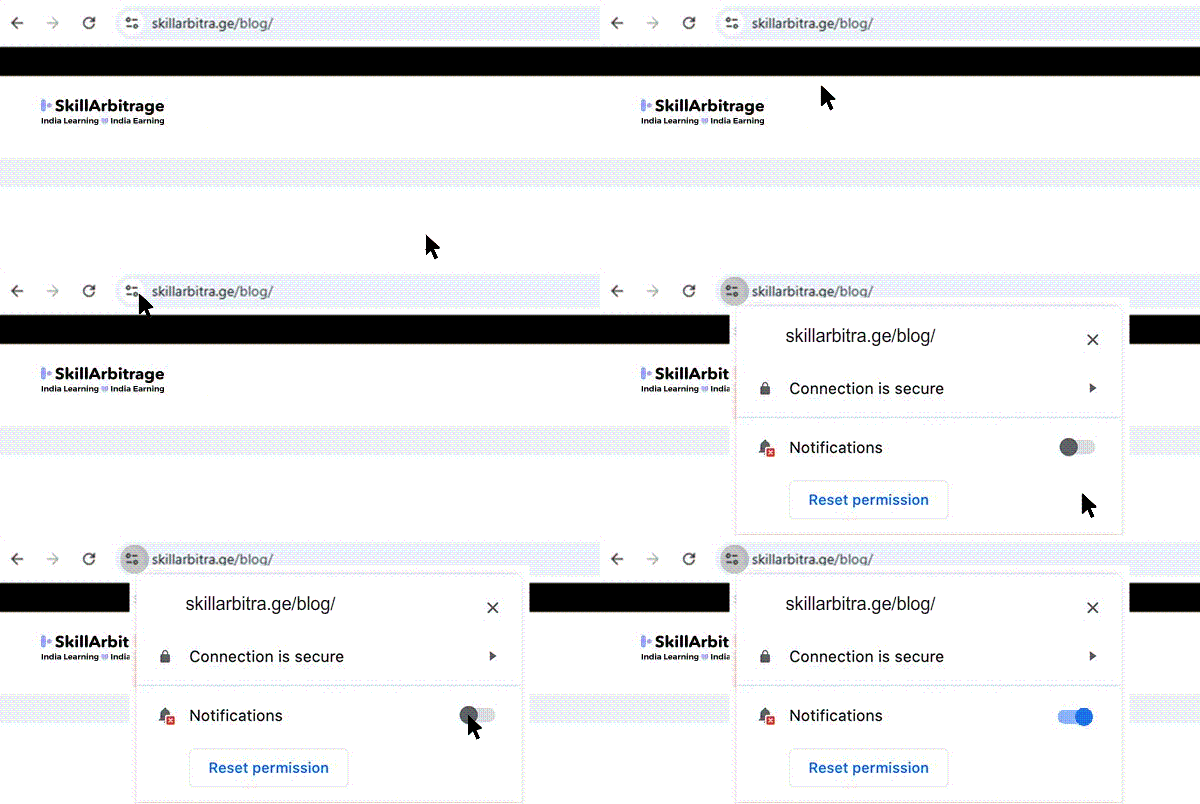
It’s encouraging to see academic writing becoming such an accessible global career, even for those without a PhD or research background. The 6-month roadmap really breaks down the steps in a practical way, which makes building credibility and landing international clients feel much more achievable. I also appreciate the focus on gradually specializing to scale income—it feels like a smart, sustainable approach.